
Fresh Ideas for First Grade Anchor Charts: Simple, Bright, and Ready to Use
Anchor charts are classroom superheroes: they make abstract ideas concrete, support independence, and turn routines into visible, reusable tools. For first graders—who are just building independence and literacy foundations—the right anchor chart can make a lesson stick for weeks. Below are fresh, practical ideas and tips for creating anchor charts that are developmentally appropriate, student-centered, and classroom-ready.
Why anchor charts matter in first grade
- They turn temporary instruction into a lasting visual reference students can use during work time.
- They support language development by showing vocabulary, sentence frames, and examples.
- When students help create them, anchor charts reinforce ownership and memory.
- Anchor charts make transitions smoother: a quick glance can remind students of expectations and steps.
If you’re planning classroom celebrations or planning home-school connections, consider pairing charts about routines with ideas for easy classroom-friendly snacks like these healthy sweet treats for toddlers that translate well to early-elementary tastes.
Design principles for first-grade anchor charts
- Keep it uncluttered: one big idea per chart. Young learners need focus.
- Use large, neat handwriting and bold colors to separate headings from examples.
- Add icons or simple drawings to support emergent readers.
- Include a “look-for” column: what excellent work looks like vs. common mistakes.
- Laminate or place charts in a pocket for repeated reference; make smaller versions for student desks if possible.
Anchor chart ideas and how to make them work
- Reading Response Chart: Simple sentence stems (I noticed…, I wonder…, This reminds me of…) with small illustrations for each stem. Refer to it during guided reading groups.
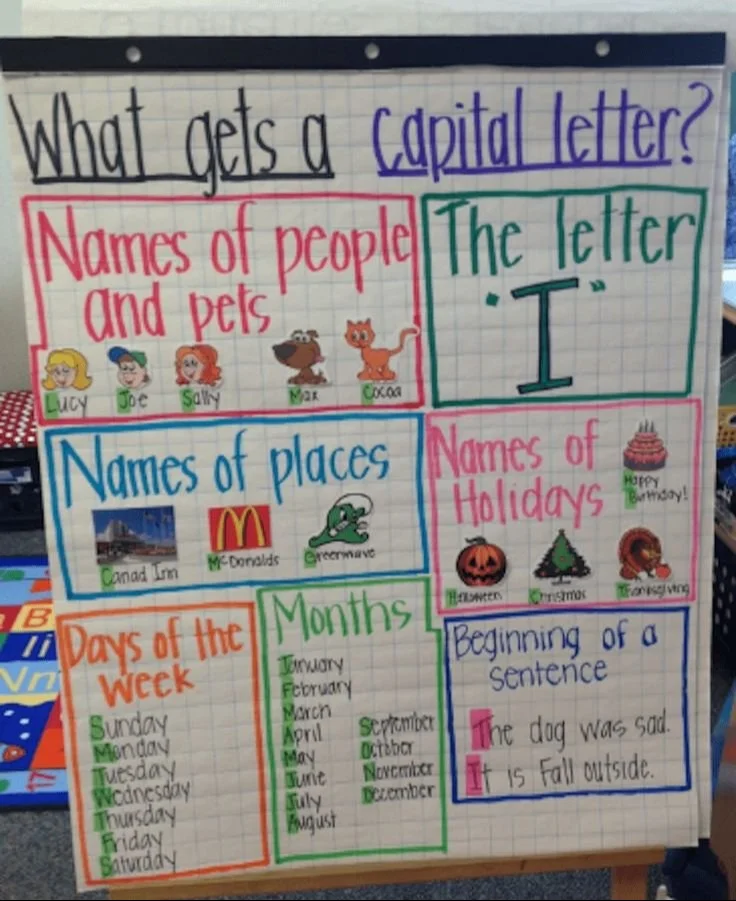
- Super Sentences Chart: Visual reminders for capital letters, spaces, punctuation, and using a reread to check meaning.
- Math Problem Solving Steps: “Read the problem,” “Draw or act it out,” “Write an equation,” “Check your answer.” Use arrows or footsteps to show sequence.
- Word Work Wall: Sort words by vowel sounds, word families, or tricky sight words with sticky-note examples that rotate weekly.
- Classroom Jobs and Routines: Draw each job, list responsibilities, and add a small student photo to reinforce ownership.
- Behavior Visuals: Use a color-coded scale or character-based prompts (e.g., “Quiet Voice,” “Hands to Yourself,” “Ask for Help”).
- Writing Checklist: Simple checklist students can use to self-edit (capitalization, spaces, finger spaces, punctuation).
- Science Inquiry Chart: Question starters, steps for experimenting, and a spot for drawing observations.
Making anchor charts interactive
- Student-created sections: Leave space to add student examples or illustrations after a lesson.
- Sticky-note ideas: Allow students to add sticky-note responses to the chart during independent work.
- Mini-anchor cards: Give each student a pocket-sized version for centers to reduce trips to the wall.
Integrating anchor charts into daily routines
- Morning Meeting Launch: Use a calendar or greeting chart to center routines and language practice.
- Transition Prompts: Create a short, illustrated anchor chart for lining up, sharing materials, or cleanup.
- Snack and Choice Times: Post clear steps for washing hands, where to put belongings, and how to return items—pair these with short classroom recipes or snack routines such as simple granola options that can be adapted from common pantry ingredients like oats and sunflower seeds; try exploring recipes that include oats and sunflower seeds for inspiration to keep snack time consistent and healthy.
Tips for longevity and reuse
- Photograph charts at the end of each week and compile a digital binder for subs or parent volunteers.
- Re-purpose charts year to year by erasing examples and swapping vocabulary for the next cohort.
- Rotate charts by theme—literacy, math, social skills—so the wall stays fresh and relevant.
Encouraging student ownership
- Let students pick chart titles or contribute artwork.
- Use student work samples on the anchor chart to celebrate progress.
- Revisit charts frequently: short, targeted mini-lessons that connect back to the chart help cement learning.
Quick printable-friendly approach
If time is tight, create a template with space for a title, three bullet points, and two kid-drawn examples. Print and laminate these templates; during the lesson, jot the key points and invite two students to illustrate. You get a neat, consistent set of charts that still includes student voice.
Conclusion
For more concrete examples and ready-to-use visuals, browse this collection of anchor-chart ideas to spark your designs: 22 Awesome First Grade Anchor Charts That We Can’t Wait to Use. If you want to deepen how you involve students in discussions as you build charts together, explore this practical resource for classroom talk strategies: the big list of class discussion strategies.